
My Kid Would Be Better If Reality Would Just Get Out of the Way
Some parents don’t watch hockey, they watch a personal documentary where their kid is always the victim.
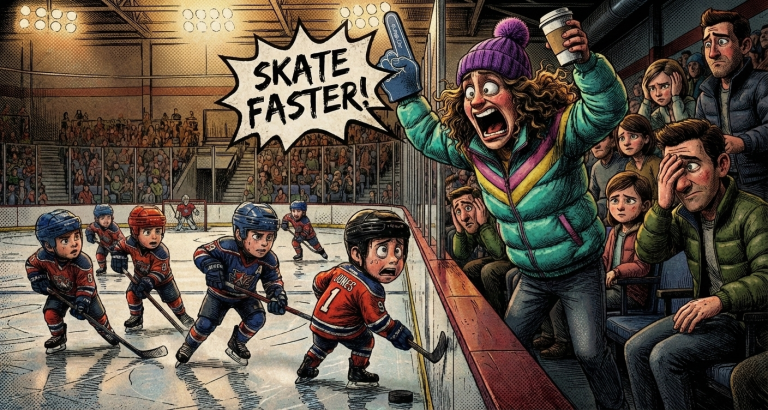
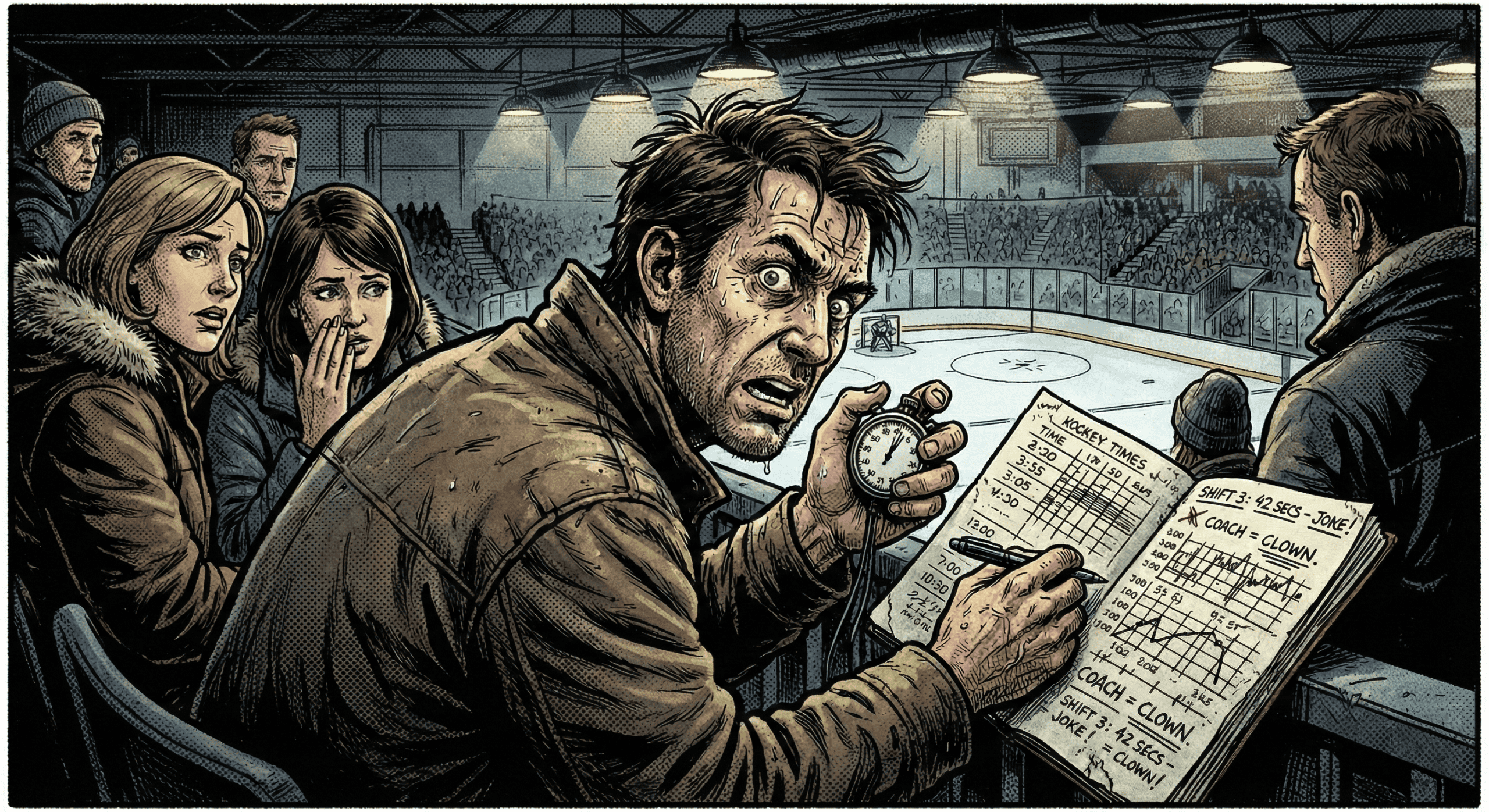
While the kids are just playing hockey… trying, learning, surviving. Making mistakes… a lot of them natural, some beyond stupid… there are parents in the stands who are spiralling over those innocent mistakes or simply lack of skill. Whispering. Counting shifts like forensic accountants. Mentally replaying every missed pass while constructing a full-blown courtroom case against the coaching staff.
And the kid?
The kid is just… a kid.
He’s chasing the puck.
He’s tired.
He’s confused by systems he didn’t design.
He’s learning in public, which is already brutal enough.
But up in the stands, reality gets rewritten in real time.
Somewhere between U7 and the first “he should be on the power play” thought, a certain parent loses all ability to process what’s actually happening on the ice. Their kid could be behind the play, struggling with pace, coughing up pucks, or coasting through shifts. Not because he’s lazy or bad, but because he’s developing. And instead of letting that be normal, the parent turns it into absurd theatre.
Suddenly, it’s not about learning anymore.
It’s about injustice.
Every mistake becomes evidence.
Every benching becomes a conspiracy.
Every other kid who scores is “just getting lucky” or “being favoured.”
The child stays innocent in all of this, just doing his best, while the adult loses their mind trying to protect an ego that doesn’t even belong to the kid.
The situation becomes ridiculous fast: grown adults emotionally melting down over ice time, attacking coaches, blaming teammates, and rewriting games that everyone else clearly watched.
Not because the kid failed.
But because the parent couldn’t handle what development actually looks like.
Hockey Hallucinations
Here’s the uncomfortable fact:
Most parents are wildly unqualified talent evaluators of their own children.
Not because they’re dumb. Not because they don’t understand the game.
It’s because they’re emotionally compromised.
You see effort where there is drifting.
You see “high IQ” where there is hesitation.
You see “unlucky” where there is consistent under performance.
Meanwhile, the kid is:
- Losing puck battles
- Late on backchecks
- Avoiding contact like it’s optional
- Producing fewer points than the third-line grinder who barely speaks
But somehow… he deserves more ice than the team’s top scorer.
Why?
Because “if he had the same chances as Johnny, he’d have just as many points, probably more.”
Sure. Give my beer league buddies McDavid’s minutes and we’re all first-ballot Hall of Famers.
Ice Time Delusion
Every team has that parent.
Their kid plays 11 minutes.
The top line plays 18.
The scoreboard explains why.
But the post-game rant sounds like this:
- “The coach just doesn’t like him.”
- “He never gets a real opportunity.”
- “They don’t use him properly.”
- “If he touched the puck on the power play, you’d see.”
What you don’t hear:
- “He turns pucks over at the blue line.”
- “He avoids traffic.”
- “He doesn’t win races.”
- “He coasts when he’s tired.”
Because that would require acceptance of reality.
The Excuse Factory
When coaches give feedback parents don’t like, excuses come out faster than a bad line change.
Here’s a completely realistic list of things that are apparently responsible for a kid not playing well:
Developmental Excuses
- “He’s a late bloomer.” (He’s been late for five years.)
- “He’s too smart for this system.”
- “He’s a play maker stuck with bad line mates.”
Nutrition & Lifestyle Crimes
- “He didn’t get enough protein today.”
- “The pregame pasta was too heavy.”
- “Dairy slows him down.”
- “He skipped breakfast and it ruined his legs.”
Personality Blame
- “He’s just too nice.”
- “His nursery school emphasized kindness too much.”
- “He is a strong kid, he just doesn’t want to hurt anyone.”
- “He plays better when people believe in him.”
- “He was good last year, but this coach has ruined his confidence”
(It’s hockey. Not a group therapy session.)
External Villains
- “The coach doesn’t understand him.”
- “The coach favours his kid.”
- “The other players don’t pass to him.”
- “The system doesn’t fit his strengths.”
Strangely, no system ever fits his strengths.
The Hardest Truth Parents Avoid
Here it is. Read it slowly.
Sometimes your kid isn’t getting better because he doesn’t actually love hockey that much. Maybe it’s because you don’t hold him accountable for effort, consistency and accepting his mistakes and learning from them. Maybe he just isn’t athletic – and that’s okay.
What’s not okay is turning that reality into a full-blown conspiracy involving:
- Coaches
- Teammates
- Politics
- Development models
- And the ghost of a preschool teacher who once said “be kind”
Some kids love hockey.
Some kids really love hockey.
Some kids just like the idea of being good at hockey.
Some kids are just doing what you tell them… so be careful what you tell them.
Takeaways (For Parents Brave Enough to Read Them)
- Ice time is earned, not owed
- Honest feedback is not a personal attack
- Players that produce and put in the effort get the ice time
- Excuses don’t develop players, accountability does
- If your kid truly wants it, his actions will show you
- Your kid is not an angel, he makes mistakes and does the wrong thing – be brave enough to accept it and correct it.
Closing
If every coach your kid ever has is “the problem,”
If every team “misuses” him,
If every top scorer is “just luckier”…
At some point, the issue isn’t development.
It’s denial.
If this is you… grow some balls, accept reality and then try to help your kid. Leave everyone else out of it.