

How the Con Works (and Why Parents Keep going)
A real tryout evaluates players. A money-grab evaluates parents wiliness to pay. A good coach will help you find the best place for development and growth. A bad one will take advantage of his position and sell the possibility of your kid getting a spot to milk you for every penny.
So lets a call a spade a spade… the majority of tryouts are con jobs
And a good con doesn’t start with stealing. It starts with selling a story.
In youth hockey, that story is always the same: “Spots are open. We’re looking. We want families who are fully committed. To make an offer, we need to see them on the ice.”
To be clear, the target isn’t the kid. It’s you – the parent – with a calendar full of hope and a wallet full of cash. And how does this story begin…. with a “birthday skate”.
Step 1: Find the Right Target
A con artist doesn’t waste time on people who won’t bite. They look for the ones who need something.
- The family whose kid didn’t make the team they wanted
- The kid who’s “close”
- The parent who keeps saying, “We just need one chance”
- The family new to the system who doesn’t know rosters are often decided early
The con is built on one ugly truth: a parent will pay almost anything to protect their kid from disappointment. That’s love. And love is easy to exploit.
Step 2: Create Scarcity and Urgency
Then comes the language. Always vague. Always exciting. Never measurable.
- “Limited spots.”
- “We’re still building.”
- “We’re looking for a few more pieces.”
- “We want commitment to development.”
They don’t say how many spots are open because the number might be zero. If the real number is zero, you can’t put that on a flyer, you can’t sell, you can’t make money. If it’s one, you can’t charge a lineup of kids to skate for it without looking like what you are.
So they keep it foggy and let your imagination do the work. And your imagination always fills in the same thing: “My kid can make it.” Because its your kid and that is completely fine. Believing in your child is a beautiful thing and its disgusting when that is exploited
Step 3: Run It Under the Radar
This is where it gets careful. A lot of (or… all) of these “birthday skate tryouts” aren’t official tryouts. They’re private skates. Quiet invites. Off-book ice. “Birthday skates”
Why? Because visibility kills scams.
If leagues, organizations, and informed parents see what’s happening, they start asking questions that ruin the business model:
- “Is this sanctioned?”
- “How many returning players are already committed?”
- “Why are you charging families when the roster is full?”
So the skate stays quiet. Invite-only. No paper trail. Just enough secrecy to keep everyone confused and compliant.
Step 4: Use Props to Sell the Illusion
Con artists use props. In these skates, the props are the returning kids:
- Half the group already knows the drills
- The coach already knows their names
- The dynamic is already set
- The “outsiders” are there to fund the ice and fill the coaches wallet.
- Maybe there is a kid everyone knows who is there, but he was invited and is skating for free.
The new families don’t always get it right away. They just feel it: something is wrong: this isn’t right. But what choice do they have?
Step 5: Deliver the Most Dangerous Sentence in Youth Hockey
This is the line that turns a normal parent into a repeat customer:
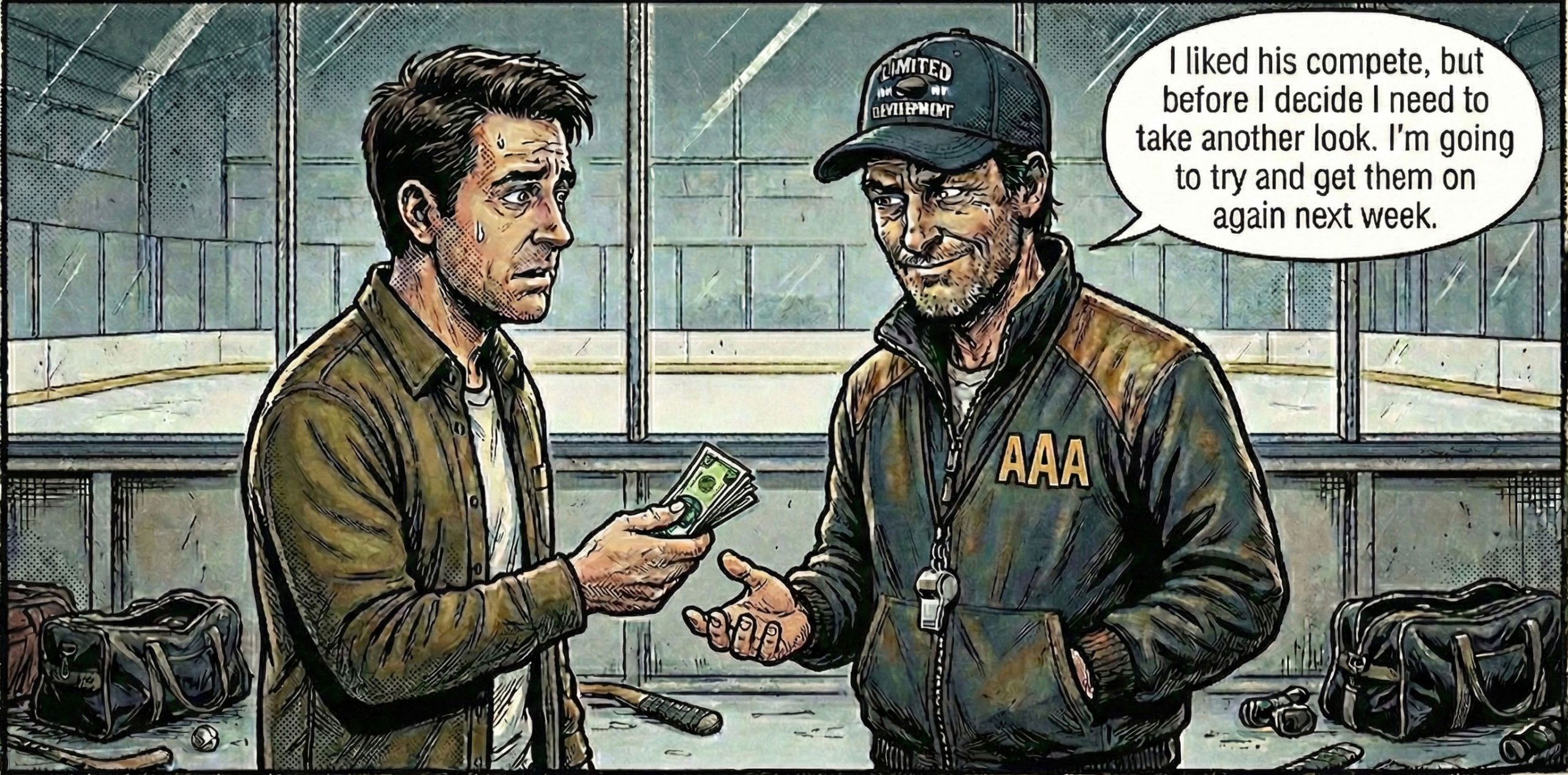
“I need another look.”
It’s not a yes. It’s not a no. It’s a hook. It’s designed to keep you alive. It makes you think you’re close. And if you’re close, you don’t walk away.
So you pay again. Again. And again. And again. Because a parent doesn’t want to be the reason their kid didn’t make it.
Step 6: Keep the Finish Line Moving
In a real evaluation, the coach can tell you what they’re evaluating. How their decisions are made and when those decisions will be made public. In a con, the criteria, the process, the communication timing, stay vague, because clarity creates accountability.
So the feedback sounds like this:
- “We like the compete.”
- “He’s coming along.”
- “We just need to see him again.”
- “Is he signed up for my camp?”
- “hoping to make a decision soon.”
Always one more. Not because they’re unsure, because the goal isn’t to decide. The goal is to continue billing.
Step 7: Offer a “Spot” That Isn’t Really a Spot
On rare occasion, they do offer a spot on the team. Usually the last one or the filler spot. The one that costs the most to obtain and delivers the least value.
- The 9th or 10th forward
- Barely plays
- Sits while others double-shift
- Gets minimal meaningful reps
- No Power play. No penalty kill. No final minute of the game shifts.
- Becomes the grocery stick when it matters
The coach still gets to say, “He needs more time to develop before I can give him those big opportunities”. But the “chance” is mostly a chance to stay your on the team, get more bench time and fork over more cash.
Step 8: Lock Them Into the Second Revenue Stream
This is the part that should make you feel sick.
Once your kid is on the team, especially as the last roster player, you become the perfect customer for “optional” extras:
- “Development skates”
- “Skills sessions”
- “Small group training”
- “Position clinics”
- “Camps”
- “Private development that focus on where he needs the most work”
The coach holds all of these training sessions, camps, small training groups, etc as “optional”, but it is by no means optional unless you want even more ice time taken away or less of chance to remain on the team. Because the kid who doesn’t attend becomes the kid who “isn’t committed”. A family who isn’t committed doesn’t pay. And what good is family that doesn’t pay to these types of coaches”
So now the family pays to try out, pays to “earn another look,” pays to make the team, and pays to stay safe from being ignored. That’s not development. That’s monetized insecurity.
And the this type of coach’s favourite kind of player isn’t the most talented. It’s the one whose parents will keep paying because they’re terrified of losing the scrap of belonging and avoiding the child from feeling disappointment. (If that’s you and it stings, good. It should. That is a good first step out of this mess.).
Quick note and important one: Your child feeling disappointment may be the best thing that every happened to them… it may spark the drive to really improve or it may push them into another interest that they can love and excel at…. the worst thing is to allow these scum bags to rob you of your money and your child’s opportunity of real development and growth.
10 Signs it’s a Money-Grab
- They won’t say how many roster spots are open.
- The skate is “private,” “quiet,” or weirdly secret.
- There’s 50 kids on the ice.
- No clear tryout timeline, criteria, or process.
- Most of the kids are wearing the team’s practice jersey.
- “I need another look” turns into a subscription.
- You never get real feedback only vague encouragement.
- Prices climb or new fees appear or new skates are required.
- “Development skates” are pushed before you’re selected.
- Decisions drag on with no explanation.
- The organizer profits from keeping you “close.”
If you’re nodding, you’re probably not trying out. You’re being milked.
Real-Life Example
A family gets the call or text to come to a “skate.” where the coach will be looking at players for selection. Payment $75.
They show up and notice half the kids already look settled, are familiar with all the drills, they all are familiar faces, have familiar conversations with the coach. The coach barely speaks to the new players.
Afterward: “Good pace. I need another look.”
Two days later: another skate invite. Another $75.
After skate four/five/six: “Still deciding. It’s a competitive age group and limited spots.”
After… skate however how many… they get offered the last spot. The kid barely plays all year. But there’s a weekly “optional” development skate, camps and other misc fees throughout the year that if not paid hurts ice time and threats of being cut get stronger.
The family ends up paying more to stay afloat than they ever paid to actually play hockey. There is so much wrong with this. We won’t go into it here, but I hope you see it or at least will soon.
What to Ask Before You Pay
A con hates direct questions. Ask them anyway:
- “How many roster spots are actually open right now?”
- “How many players are returning or already committed?”
- “Is this skate sanctioned and part of the official tryout process?”
- “What are the evaluation criteria?”
- “When are final decisions made and how are they communicated?”
- “How many paid skates will there be?”
If they dodge, deflect, or get annoyed, it’s not because it’s complicated. It’s because clarity kills the hustle. It’s a clear sign to find a new coach and team.
Takeaways
- If the roster is full, charging families to “be seen” is deceptive, predatory, and exploitative.
- “I need another look” is often not evaluation, it’s a sales tactic.
- A “spot” with no ice, no trust, and no real development isn’t an opportunity.
- Parents need transparency: spots, criteria, timeline, and whether it’s sanctioned.
- If you find yourself in this situation, get out as fast you can. It’s hard. Your might not be able to the first time and that’s ok…. just be aware and try. Eventually, you’ll know the difference and have no trouble finding a different opportunity with character coaches and families.
Final Buzzer
This isn’t a misunderstanding. It’s an accepted system.
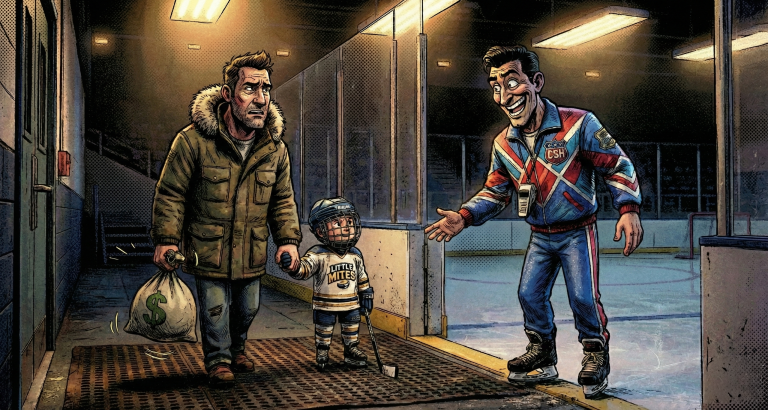
And the only reason it keeps happening is because decent parents don’t want to believe someone would use their kid’s dream… as bait… as a money making ploy. And maybe even a little because parents feel they don’t’ have a choice… it is what it is and you have to play “the game”.
But remember… that’s exactly what a con man does. He doesn’t steal your money. He makes you hand it over… and thank him for the chance.
Sounds familiar?




Very familiar unfortunately